Knowing how to negotiate a brand deal as a creator in India is the single most underrated skill a new creator can build — and most never even try.
To negotiate a brand deal as a creator in India, prepare three things before any conversation: a written rate card based on your engagement rate, a media kit with your audience data, and a clear floor price you will not go below. When the brand makes their first offer, never accept it as-is — counter once with a value-anchored response, get every term in writing before creating content, and insist on a contract that includes payment timeline, usage rights, and a kill fee. The negotiation isn't about being aggressive; it's about being prepared.
How to Negotiate a Brand Deal in India: Why Most Creators Leave Money on the Table
Most creators accept the first offer a brand throws at them. And over the course of your career, that decision costs you thousands.
Here's the uncomfortable truth: brands know you're inexperienced. They know you're hungry for portfolio pieces. They know you're intimidated by contracts and uncomfortable talking about money. And they're counting on all of that to lowball you, load you with unrealistic deliverables, and lock you into terms that benefit them far more than you.
Is Negotiation Really a Skill You Can Learn?
Absolutely. Negotiation isn't some dark art reserved for seasoned professionals. It's a skill. And like any skill, it gets easier the more you practice it — starting with your very first deal.
What Will You Learn in This Guide?
This guide walks you through exactly what negotiating your first brand deal actually looks like. We'll cover how to prepare before you even pick up the phone, how to spot red flags in those initial conversations, how to push back on unfair terms, what a contract should protect, and how to manage the relationship once you've signed. By the end, you'll have a framework that turns brand negotiations from something terrifying into something tactical.
Section 1: What Should You Do Before a Brand Even Contacts You?
The biggest mistake new creators make is thinking negotiation starts when a brand slides into your DMs. It doesn't. Negotiation starts weeks before that — in how well you know yourself, your audience, and your worth.
Do You Actually Know Your Numbers?
Before you negotiate anything, you need to know your metrics cold. Engagement rate, average reach per post, impressions, story views, saves, shares — these are your leverage. Brands don't just pay for followers. They pay for influence, and influence is proven through data.
A creator with 8,000 followers and a 9% engagement rate is worth more to a brand than one with 50,000 followers and 0.8% engagement. Know your numbers so you can speak to them confidently.
Have You Built Your Media Kit?
Your media kit is your professional introduction. It should include your niche, audience demographics, key metrics, content samples, platforms you're active on, and past collaborations if any. Think of it as your resume — you wouldn't walk into a job interview without one.
If you don't have a media kit yet, build one before you start pursuing brand deals. It signals professionalism and immediately sets you apart from creators who are just winging it.
Creator Scout Tip: Instead of building and updating a media kit manually every few months, sign up on Creator Scout and get a personalised media kit link with verified stats — creatorscout.in/yourname. Share that link directly with brands. Your stats update automatically, so you never have to worry about sending outdated numbers again.
Do You Know What to Charge?
This is where most creators freeze. Pricing yourself feels awkward, especially early on. But going into a negotiation without a rate card is like going to a market without knowing the price of your goods.
A general starting point: charge per 1,000 followers per post, adjusted by your engagement rate and platform. Instagram Reels typically command more than static posts. YouTube integrations command more than Instagram. Factor in usage rights, exclusivity, and the effort required for the content type. Know your floor — the minimum you'll accept — and your ideal rate. Never start the conversation without both numbers in your head.
Quick Rate Floor Calculator — a starting formula for nano/micro creators (under 50K followers):
Base = (followers ÷ 1,000) × ₹500
Engagement adjustment = +20% per percentage point above 3% ER (or –20% per point below)
Format adjustment = × 1 for static, × 2 for Reel, × 3 for YouTube integration
Usage rights = + 50% if brand wants to run as a paid ad
Exclusivity = + 25% per 30 days locked out of category
Example: a creator with 8K followers, 6% ER, doing one Reel with no usage rights and 30-day exclusivity.
Base: 8 × ₹500 = ₹4,000
ER adjustment: +60% (6% ER is 3 points above 3% baseline) → ₹6,400
Format: × 2 for Reel → ₹12,800
Exclusivity: + 25% → ₹16,000
Floor = ₹16,000. Ideal rate = ₹20,000–₹24,000. Never quote below floor.
Creator Scout Tip: Not sure what to charge? On Creator Scout, you can see what brands in your category are actually paying creators at your tier — so you're pricing based on real market data, not guesswork.
Have You Researched the Brand?
Before responding to any brand inquiry, spend 15 minutes researching them. What do they sell? Who is their target customer? Have they worked with creators before? What does their content look like? Do their values align with yours?
This research does two things: it protects you from wasting time on a brand that's a bad fit, and it arms you with talking points that make you sound like a genuine partner rather than someone just chasing a paycheck.
Are Your Content Boundaries Clear?
Know what you will and won't promote before a brand asks. Certain categories — alcohol, gambling, fast fashion, specific political affiliations — might not align with your personal brand or audience trust. Define your boundaries early so you're never caught off guard by an offer that puts you in a compromising position.
Section 2: What Should You Expect in the First Conversation With a Brand?
The initial conversation sets the tone for the entire deal. How you show up here determines whether the brand sees you as a professional partner or an easy target.
How Do You Respond to a Brand's First Message Professionally?
Whether it comes via DM, email, or a platform like Creator Scout, your first response matters. Keep it professional, warm, and curious. Acknowledge their interest, ask a few clarifying questions, and avoid discussing numbers in the very first reply.
First-Response Template (copy this):
"Hi [Brand Name], thanks for reaching out — I'd love to learn more about the campaign.
Could you share:
Exact deliverables (post format, platform, count)
Timeline for delivery and go-live
Budget range allocated for this campaign
Whether there's an exclusivity clause and for what duration
Once I have these I can put together a tailored proposal. Looking forward to hearing more.
[Your name]"
This single message does five things at once: signals professionalism, gets the brand to commit to a budget range before you reveal yours, surfaces exclusivity early (the most expensive hidden term), and filters out brands who won't put anything in writing.
What Questions Should You Ask Upfront?
Before you get into any negotiation, you need answers to these questions:
What are the exact deliverables? (Number of posts, format, platform)
What is the timeline for content creation and going live?
Is there an exclusivity clause, and how long does it run?
What is the budget range for this campaign?
Who owns the content after it's posted?
How many revision rounds are included?
Getting these answers early prevents misalignment later and shows the brand you know what you're doing.
How Do You Avoid Underselling Yourself in the First Interaction?
The moment you throw out a number lower than your floor, you've lost. Brands will anchor to that number and every negotiation from that point will be downward.
If a brand asks for your rates before sharing their budget, flip it: "I'd love to hear what budget you have allocated for this campaign so I can see what we can put together." This keeps you from revealing your hand before you need to.
How Do You Spot a Genuine Brand Inquiry vs. a Gifting Trap?
This is one of the most important skills you'll develop as a creator — and one that can save you real money.
Here's a real scenario playing out across the creator industry right now: A brand reaches out offering a "paid collaboration." They tell you they'll send you a product, you create the content, and they'll reimburse you within 30 to 60 days. Sounds fair enough, right?
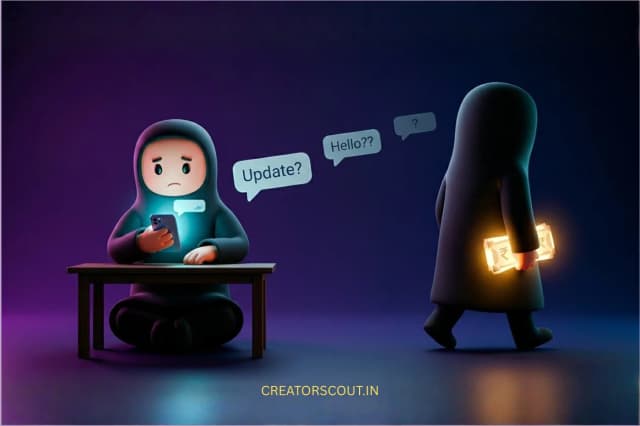
Here's where it gets exploitative. Instead of sending you the product directly, they ask you to purchase it yourself from Amazon or their website, upload your review or reel, and then wait for reimbursement. The amount is small — maybe ₹500 to ₹1,000. But the follow-up process is anything but small. Creators end up sending multiple messages, making repeated calls, chasing a contact who keeps pushing the timeline. Eventually, most just give up and leave the money on the table. The brand gets free content. The creator gets nothing.
Red flags to watch for:
Brand asks you to purchase the product yourself before any payment is confirmed
Reimbursement timelines are vague — 30, 45, 60 days with no written terms
No agreement before you're asked to take any action
Urgency pressure to post before payment or contract is confirmed
Communication feels informal and unstructured
A genuine brand inquiry will have a clear brief, a clear budget, and a willingness to put terms in writing before asking you to do anything.
Creator Scout Tip: Every brand on Creator Scout is verified before they can reach out to creators. That means the gifting trap scenario above is significantly reduced — you're dealing with brands that have committed to a structured, transparent collaboration process from day one.
Section 3: How Do You Actually Negotiate the Deal?
This is where most creators go silent. They get an offer, they feel it's low, but they don't know how to push back without seeming difficult. Here's the truth: pushing back professionally is exactly what brands expect from serious creators.
How Do You Counter-Offer Without Sounding Greedy?
Simple. Anchor your counter in value, not in ego.
Instead of: "That rate is too low for me."
Try: "Based on my engagement rate and the deliverables you've outlined, my standard rate for this would be ₹X. I can work with your budget if we adjust the scope, but I want to make sure we're both getting value from this partnership."
That's professional. That's confident. And it opens a conversation rather than closing one.
Counter-Offer Template (use when the offer is below your rate):
"Thanks for the offer — appreciate you sharing the budget upfront.
Based on my current engagement rate of [X%] and the deliverables outlined, my standard rate for this scope is ₹[Y]. I'd love to make this work — a few ways we can structure it:
Option 1: [Y] for the full scope as outlined
Option 2: [original offer] for a reduced scope — fewer deliverables / shorter exclusivity / no usage rights
Option 3: [Y] but split across two campaigns over the next 60 days
Let me know which works for your team."
Anchored in data (engagement rate), offers three paths instead of one, and reframes "no" as "yes, with adjustments." Brands almost always pick Option 2 or 3 — and you keep your rate intact.
How Do You Handle Pushback on Your Rates?
Brands will push back. That's normal. When they do, don't immediately drop your rate. Instead, adjust the scope.
If they can't meet your rate, offer fewer deliverables. One reel instead of two. No usage rights. A shorter exclusivity window. You're not compromising your worth — you're restructuring the deal to fit their budget while protecting your rate per deliverable.
What Else Can You Negotiate Beyond Money?
Money is just one piece of the deal. Experienced creators negotiate the full package:
Usage rights: Can the brand use your content in their ads? That costs extra.
Exclusivity: Are you locked out of working with competitors? For how long? That costs extra too.
Revision rounds: How many rounds of edits are included before additional charges apply?
Credit and tagging: Will they tag you in their reposts? Will they credit you properly?
Approval timeline: How quickly will they review and approve your content?
Every one of these is negotiable. Every one of these has value.
When Should You Walk Away?
Walk away when a brand refuses to put anything in writing, when the payment terms are unreasonably long with no guarantee, when they keep expanding the scope after the deal is agreed, or when your gut tells you something is off. No deal is better than a bad deal. Your time, content, and reputation are worth protecting.
Polite Decline Template (use when the deal isn't right):
"Thanks so much for the consideration — I've thought about it and the [budget / timeline / exclusivity terms / scope] aren't quite the right fit for me on this one. Really appreciate you reaching out and I'd love to stay in touch for future campaigns where the brief aligns better. All the best with the launch."
Keeps the door open. "Right fit" framing makes it about alignment, not rejection. About 30% of declined brands come back within 6 months with a better offer — make sure they remember you warmly.
Section 4: What Should You Look for in the Contract?
A verbal agreement is not an agreement. If it's not in writing, it doesn't exist. This is non-negotiable.
What Key Terms Must Every Creator Understand?
Exclusivity clause: Defines whether and how long you're restricted from working with competing brands. Always negotiate the duration and the definition of "competitor."
Usage rights: Defines where and how the brand can use your content. Organic posts, paid ads, billboards — each is different and each should be priced differently.
Kill fee: If the brand cancels after you've done the work, what do you get paid? Always have a kill fee clause.
Payment terms: Net 15, Net 30, Net 45 — know what you're agreeing to and always push for the shortest timeline possible.
Deliverables and deadlines: Exact list of what you're creating, in what format, by when.
Revision rounds: How many are included? What happens if they exceed that number?
What Are the Biggest Red Flags in a Contract?
Unlimited revision clauses with no additional cost
Exclusivity periods longer than 3 months for a single campaign
Ownership of your content transferred permanently to the brand
No kill fee clause
Payment only after brand approval — meaning they could delay approval indefinitely
Vague deliverable descriptions that can be interpreted broadly
What Should You Never Sign Without?
Never sign a contract without a clearly defined payment timeline, a specific list of deliverables, a kill fee, and a usage rights clause. If any of these are missing, ask for them to be added before you sign anything.
Creator Scout Tip: When you close a deal through Creator Scout, the agreement structure is built into the platform — deliverables, timelines, payment terms, and revision rounds are all documented in one place. No chasing paperwork, no ambiguous verbal agreements.
Section 5: How Do You Manage Deliverables and Timelines?
Signing the contract is just the beginning. How you manage the execution determines whether this brand becomes a long-term partner or a one-time headache.
How Do You Set Realistic Deadlines?
Always negotiate deadlines with buffer time built in. If you think you can deliver in 5 days, commit to 7. Life happens. Equipment fails. Creative blocks are real. Under-promise and over-deliver — it's a simple principle that builds trust fast.
How Do You Handle the Approval Process?
Get the approval process in writing. How many business days does the brand have to review your content? What happens if they don't respond within that window? Who is the point of contact for approvals?
Brands that leave creators waiting indefinitely for approvals — especially when the content has a time-sensitive hook — are a red flag. Build a response deadline into your contract.
What Happens if a Brand Ghosts You After Delivery?
It happens. You deliver the content, they go silent. Here's what you do: follow up once professionally, then twice, then send a formal payment reminder referencing the contract terms. If they continue to ignore you, you have a signed contract — which means you have legal recourse. This is exactly why getting everything in writing matters.
Payment Follow-Up Sequence:
Day 0 (invoice sent): Send the invoice, confirm receipt within 48 hours.
Day 14: Light reminder. "Hi [name], just a gentle nudge on invoice #[X] — let me know if you need anything from my side to process it."
Day 28: Firm reminder citing contract. "Per our agreement signed on [date], payment was due within Net 30. Could you share an updated timeline?"
Day 35: Escalate to finance/founder. CC the original point of contact.
Day 45+: You have a signed contract. Send a formal demand notice (a CA or junior lawyer can draft one for ₹500–₹1,000). Mention you'll pursue Section 138 if it's a bounced cheque or small claims recovery if it's a missed transfer.
Most ghost-payments resolve at the Day 28 stage when the brand realises you're tracking the contract terms specifically. Vague creators get ignored. Specific creators get paid.
Section 6: How Do You Build a Long-Term Brand Relationship?
One deal well executed is worth ten deals poorly managed. Brands talk to each other. Your reputation travels further than your follower count.
How Do You Handle Feedback and Edits Professionally?
Receive feedback graciously, even when you disagree. If you think the edit request is outside the agreed scope, say so calmly and reference the contract. "I'd love to accommodate this — since it falls outside the revision rounds we agreed on, I'd need to charge ₹X for the additional round." Professional. Clear. Fair.
How Do You Secure Repeat Collaborations?
Deliver on time. Communicate proactively. Exceed the brief where you can. After the campaign wraps, send a short performance summary — reach, engagement, saves, link clicks if applicable. Brands love data. Showing them the results of their investment positions you as a strategic partner, not just a content vendor.
Creator Scout Tip: Your Creator Scout analytics dashboard gives you all the performance data you need to put together that post-campaign summary — reach, engagement, audience breakdown — in minutes. Use it to show brands the ROI of working with you and make the case for the next collaboration before they even ask.
How Do You Protect Your Reputation?
Only promote products you genuinely believe in. Your audience trusts you — that trust is your most valuable business asset. One inauthentic collaboration that your audience sees through can do more damage than the deal was worth. Protect it fiercely.
Section 7: What Are the Most Common Mistakes First-Time Creators Make?
Accepting the First Offer Without Negotiating
Brands rarely lead with their best offer. The first number is a starting point, not a final answer. Always counter, even if it's just once.
Not Having a Written Agreement
A DM saying "we'll pay you ₹5,000 for a reel" is not a contract. Get it in writing, always, no exceptions.
Ignoring Exclusivity Clauses
An exclusivity clause that locks you out of an entire category for 6 months can cost you far more than the deal paid. Read every clause. Negotiate every clause.
Undercharging Because of Imposter Syndrome
You built an audience. You create content that people engage with. That has real, measurable value. Charge accordingly. Imposter syndrome is normal — don't let it write your rate card.
Not Sending an Invoice
A lot of first-time creators don't send a proper invoice — they just wait for the brand to initiate payment. That's a mistake. A professional invoice creates a paper trail, sets a clear payment deadline, and signals that you run your content business seriously.
Creator Scout Tip: Use Creator Scout's built-in invoice generator — fill in your details, add the deliverables and agreed amount, and send it directly to the brand in one click. No templates to download, no formatting to stress over.
Section 8: What Indian Creators Actually Need to Know About Tax, PAN, and Payment Norms
This is the section nobody writes. Every "how to negotiate" guide online is written for US/UK creators. The legal and tax mechanics of getting paid as a creator in India are completely different — and brands often won't volunteer this information because confused creators are easier to underpay.
Do You Need to Charge GST on Brand Deals?
If your total income from brand deals (plus any other business income) is under ₹20 lakh a year, you don't need to register for GST. Most nano and micro creators fall well under this threshold.
Once you cross ₹20 lakh, GST registration is mandatory and you must charge 18% GST on top of your rate. This is on top of your fee, paid by the brand to the government — it doesn't reduce your take-home. Many brands prefer working with GST-registered creators because they can claim input tax credit, so registration can actually unlock bigger deals once you're scaling.
How Does TDS Work and How Much Will You Actually Receive?
TDS (Tax Deducted at Source) is the brand cutting income tax from your payment before they send it. You claim it back when you file your annual ITR.
Two rates apply depending on how the deal is structured:
0.1% TDS if the deal is routed through a platform (Section 194-O, e-commerce) — and you have shared your PAN.
5% TDS without PAN (Section 206AA penalty rate) — never let this happen, always share PAN.
10% TDS on direct brand payments off-platform (Section 194-J, professional services).
So if a brand directly pays you ₹10,000 off-platform, you receive ₹9,000. The ₹1,000 sits with the government in your PAN's name — you reclaim it at ITR time. If the same ₹10,000 deal goes through a verified platform like Creator Scout, you receive ₹9,990 (only 0.1% deducted).
What Documents Should You Share — and What Should You Never Share?
Brands will sometimes ask for documents. Here's the line:
PAN — Share. Mandatory for any deal above ₹30,000 a year per brand. Without it, you'll be hit with the 5% penalty TDS rate.
Cancelled cheque or bank details — Share. Needed for NEFT/RTGS payment.
GST certificate — Share, if you're registered.
Aadhaar — Do not share. No legitimate brand needs your Aadhaar for a content collaboration. If they insist, it's either incompetence or a red flag. Walk away.
Passport / driving licence — Do not share. Same logic as Aadhaar.
A genuine brand finance team will only ever ask for PAN, bank details, and an invoice.
What Are Realistic Payment Timelines in India?
Brand payment terms in India trend longer than Western markets. Here's what's normal vs what's a red flag:
Net 15 (paid within 15 days of invoice) — Excellent, rare. Push for this.
Net 30 — Standard for most Indian brands. Accept without pushback.
Net 45 — Common with mid-sized D2C brands. Negotiate down to 30 if you can.
Net 60 — Common with larger brands and agencies. Acceptable for high-value deals only.
Net 90 or "pay after campaign approval with no fixed timeline" — Walk away. This is a known delay tactic; some brands push payment to Net 120 in practice, and you have minimal recourse.
Always specify the payment timeline in the contract. If they refuse to commit to a fixed number of days, you don't have a deal — you have a hope.
How Do You Send a Proper Invoice as an Indian Creator?
A compliant Indian invoice for brand deal income includes:
Your full name and address
Your PAN (mandatory)
Your GSTIN (if registered)
Invoice number and date
Brand's name, address, and GSTIN
Description of services delivered (e.g., "1× Instagram Reel, 1× Story sequence")
Amount in INR
GST breakdown (if applicable)
Payment terms and bank details for NEFT
Without a proper invoice, you have weaker legal standing if the brand delays or refuses payment. A WhatsApp message saying "₹5,000 for the reel" is not a tax document.
Creator Scout Tip: Our built-in invoice generator handles all of this — PAN, GST, deliverable breakdown, NEFT details — in one click. It also stores invoices against the brand so you have an audit trail if a payment dispute ever happens.
Do You Need to File ITR if Brand Deals Are Your Only Income?
If your total annual income (across all sources) exceeds ₹2.5 lakh, you must file an ITR — even if your only source is brand deals. Filing also lets you claim back the TDS that brands deducted.
Treat brand deal income as "Income from Business or Profession" (not "Other Sources") when filing. Use ITR-3 or ITR-4 depending on whether you opt for presumptive taxation. A CA's fee for filing this is usually ₹1,500–₹3,000 a year and is fully worth it the first time you do it — they'll also tell you which expenses (camera gear, editing software, internet bills) you can deduct.
What About Cash-in-Hand Offers?
Some brands — usually smaller local ones — will offer to pay you in cash to avoid TDS and invoicing. Tempting because you get the full amount immediately. Don't take it.
Three reasons:
No paper trail means no legal recourse if the brand under-delivers or refuses to honour the deal.
Unreported income above ₹2.5 lakh annually is tax evasion — small risk individually, real risk if you scale.
Cash deals signal to the market that you're not a professional operator. Brands talk; serious brands don't pay cash.
Always insist on bank transfer with a proper invoice. If the brand can't or won't do that, they are not a brand you should be working with.

![Influencer Outreach Management in India: The Real Cost of Doing It on Google Sheets [2026]](/_next/image?url=https%3A%2F%2Fmedia.creatorscout.in%2Fblog-covers%2F1780482721229-be86.webp&w=640&q=75)